One of the most honest ways to measure growth is to pause and look back. Not to judge the year, but to observe it. To notice what changed in the way you think, react, choose, and relate to the world.
Progress rarely announces itself loudly. It accumulates quietly, through exposure, reflection, and repetition.
None of us is self-made. Identity is not built in isolation, but assembled over time, from everything we allow to influence us, day after day.
- The people whose thinking stretches yours reshape your inner standards.
- The conversations and experiences you move through recalibrate how you interpret reality.
- The books, podcasts, and documentaries you consume slowly rewire your mental models.
- The stories you watch expand your emotional range, allowing you to understand lives you haven’t lived.
- The music you return to regulates your inner tempo.
- The places you visit alter your sense of scale and possibility.
- The habits you practice today quietly decide who you become tomorrow.
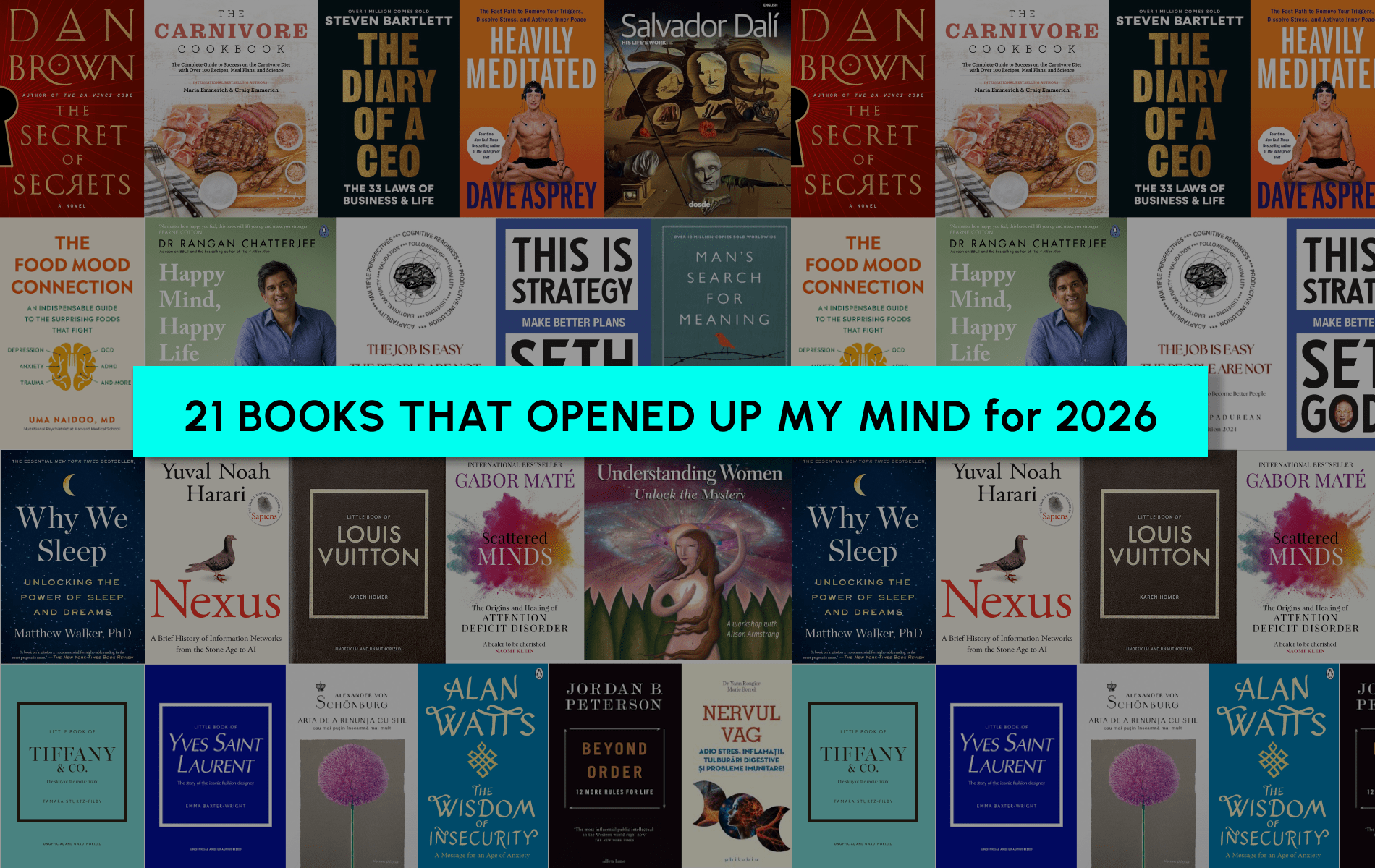
Taking this retrospective exercise myself, I mapped the ideas that challenged me, grounded me, and occasionally unsettled me in 2025. What follows is a list of books that subtly changed how I see the world.
Here they are.

1 Salvador’s Dalí: Lifework by Dosde
This book isn’t just about Dalí’s art, it’s about permission. Permission to distort reality, to exaggerate identity, to turn obsession into fuel. Dalí’s life work shows how genius is rarely tidy. It thrives in contradiction, provocation, and fearless self-mythology. The key idea here is that creativity isn’t polite. It demands intensity, ego, and an unapologetic relationship with one’s inner chaos.

2 Diary of a CEO by Steven Bartlett
At its core, this book is about emotional honesty in leadership. Bartlett dismantles the myth of the invincible founder and replaces it with something far more useful: self-awareness. The key idea is that growth, both personal and professional, accelerates when you stop hiding your fears and start interrogating them. Success doesn’t come from certainty, but from continuous self-questioning.

3 Beyond Order by Jordan Peterson
This book explores the tension between structure and freedom. Peterson argues that too much order suffocates life, while too much chaos destroys it. The key idea is learning how to consciously walk the line between the two. Responsibility, meaning, and growth come not from comfort, but from voluntarily confronting what feels uncomfortable, confusing, or heavy.

4 Nexusby Yuval Noah Harari
Harari zooms out to look at humanity as a system at a crossroads. The key idea here is interconnection. Technology, biology, politics, and belief systems are no longer separate forces. They feed into each other at unprecedented speed. The book invites a sobering realization: the future won’t be shaped by intelligence alone, but by wisdom, restraint, and ethical clarity.

5 The Food-Mood connection by Uma Naidoo
This book reframes mental health through the lens of biology. The key idea is that what we eat directly influences how we think, feel, and cope. Anxiety, depression, focus, and emotional stability are deeply linked to gut health. Naidoo bridges neuroscience and nutrition, showingthat mood is not just psychological, it’s profoundly biochemical.

6 Understanding Women by Alison Armstrong
At its heart, this book is about translation. Armstrong explains how men and women often operate from fundamentally different internal operating systems. The key idea isn’t blame or superiority, but comprehension. Conflict decreases dramatically when we stop assuming intent and start understanding design. Emotional safety and clarity begin with curiosity.

7 Scattered Minds by Gabor Maté
This book challenges the medicalized view of ADHD. Maté’s key idea is that scattered attention is often a response to early emotional environments, not a defect. Sensitivity, creativity, and intensity are frequently mislabeled as disorders. Healing starts not with correction, but with compassion and context.

8 The job is easy, the people are not by Loredana Pădurean
This book addresses the hidden complexity of modern organizations. The key idea is that performance problems are rarely technical, they are relational. Culture, communication, unspoken expectations, and emotional intelligence shape outcomes more than strategy decks. Leadership is less about managing tasks and more about managing human dynamics.

9 Heavily Meditated by Dave Asprey
Asprey reframes meditation as a performance tool, not just a spiritual practice. The key idea is intentional nervous system regulation. Meditation becomes a way to rewire stress responses, sharpen cognition, and upgrade resilience. Inner stillness is positioned as a competitive advantage, not an escape.

10 Yves Saint Laurent by Emma Baxter-Wright
This is a story about identity through design. The key idea is that fashion can be cultural rebellion. Yves Saint Laurent redefined gender norms, power, and self-expression. Creativity here is shown as a response to inner fragility transformed into aesthetic strength.

11 Înțelepciunea nesiguranței by Alan Watts
Watts dismantles the illusion of control. The key idea is that the more we chase certainty, the more anxious we become. Peace emerges when we accept impermanence as the natural state of life. This book invites a radical shift: to trust the flow instead of trying to dominate it.

12 This Is strategy by Seth Godin
Godin strips strategy down to its essence. The key idea is that strategy is about choosing who you are and who you’re not. It’s not tactics, noise, or hustle. It’s long-term thinking, grounded in values and patience. Real strategy requires the courage to disappoint some people in order to truly serve others.

13 Arta de a renunța cu stil by Alexandrei von Schönburg
This book is a meditation on elegant detachment. The key idea is that knowing when to let go is a form of intelligence. Renunciation here isn’t failure, but refinement. A conscious decision to preserve energy, dignity, and perspective in a world obsessed with accumulation.

14 Nervul Vag by Yann Rougier
Rougier brings attention to the body’s hidden command center for calm and resilience. The key idea is that healing doesn’t start in the mind alone, but in the nervous system. Breath, posture, rhythm, and connection regulate how safe or threatened we feel. Longevity begins with regulation.

15 The Secret of Secrets by Dan Brown
Beyond the thriller elements of the book, the key idea is humanity’s timeless obsession with consciousness and the hidden knowledge layer of the world.
On the surface, it’s a thriller. Beneath it, it’s a catalyst for curiosity.
Brown weaves human consciousness into a suspense-driven narrative that doesn’t aim to explain, but to provoke. The real power of the book lies in what happens after you read it: searching, questioning, exploring neuroscience and the limits of human awareness.
When fiction pushes readers toward science and philosophy, it stops being entertainment and becomes an invitation to expand the mind.

16 The Carnivore Cookbook by Maria & Craig Emmerich
This book challenges nutritional dogma. The key idea is metabolic simplicity. By reducing dietary complexity, some people regain clarity, energy, and hormonal balance. It’s less about meat itself and more about questioning one-size-fits-all health narratives.

17 Louis Vuitton Brand Book by Karen Homer
This book decodes brand as legacy. The key idea is that great brands are cultural storytellers, not just product creators. Louis Vuitton succeeded by blending heritage with continuous reinvention despite the environmental challenges. Consistency and evolution coexist when purpose is clear.

18 Man’s Search for Meaning by Viktor Frankl
At its core, this is a book about inner freedom. Frankl’s key idea is that meaning can exist even in suffering. While circumstances may be stripped away, the ability to choose one’s attitude remains. Purpose becomes the ultimate survival mechanism.

19 Happy Mind, Happy Life by Dr. Rangan Chatterjee
This book emphasizes simplicity in mental health. The key idea is that small, consistent habits shape emotional wellbeing more than dramatic interventions. Thought patterns, routines, and self-talk quietly build either resilience or burnout.

20 Why We Sleep by Matthew Walker
Walker reframes sleep as non-negotiable biology. The key idea is that sleep is foundational to memory, immunity, emotional regulation, and longevity. Cutting sleep is not a productivity hack, but a slow cognitive and physical erosion. Sleep is not rest from life, it’s preparation for it.

21 Tiffany & Co. Brand Book by Tamara Sturz Filby
This book reinforces the idea that true luxury isn’t loud. It’s recognizable without explanation. Tiffany’s power lies in creating desire through trust, timelessness, and cultural memory rather than constant reinvention.